
The promise of blockchain technology is immense: a decentralized, secure, and transparent future. However, as more users flock to this revolutionary technology, a fundamental challenge has emerged—the Blockchain Scalability Trilemma. This concept, coined by Ethereum co-founder Vitalik Buterin, is the single biggest hurdle preventing mass adoption.
For investors in Vietnam, from Ho Chi Minh City to Hanoi, understanding this trilemma is not just academic. It directly impacts transaction fees, network speed, and the long-term value of your crypto assets. This guide will dissect the scalability trilemma and explore the innovative solutions designed to solve it. We will equip you with the knowledge to navigate the next generation of blockchain technology, whether you are a beginner making your first trade on HIBT or a seasoned investor managing a diverse portfolio.
What is the Blockchain Scalability Trilemma?
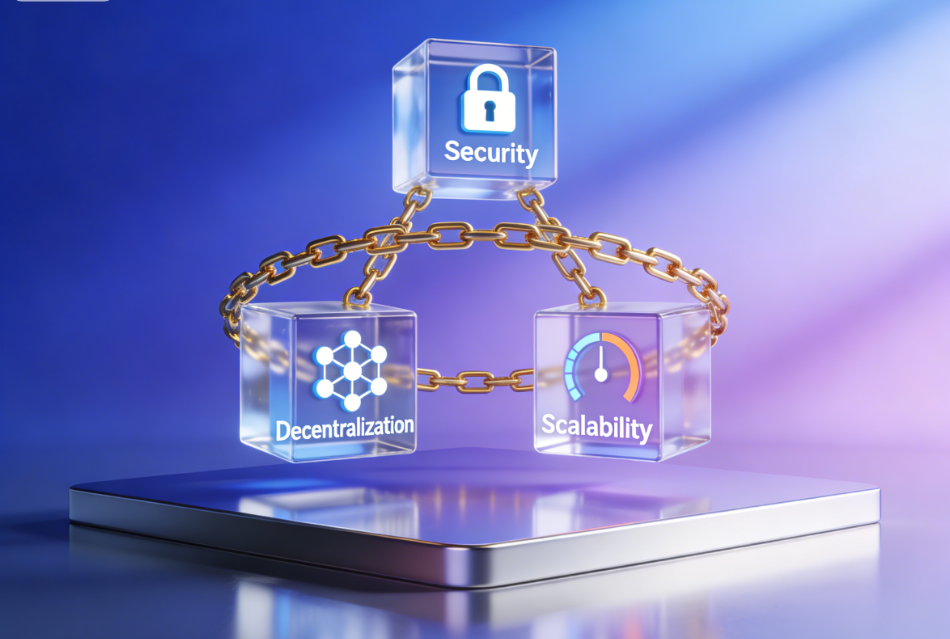
The Blockchain Scalability Trilemma states that it is extremely difficult for a blockchain to achieve three critical properties simultaneously:
- Decentralization: The network is controlled by a distributed group of participants, not a single entity. This prevents censorship and ensures no single point of failure.
- Security: The network is resistant to attacks and can defend itself against malicious actors attempting to disrupt or take control of the ledger.
- Scalability: The ability of the network to process a large number of transactions quickly and at a low cost. This is measured in transactions per second (TPS).
Think of it as a triangle. You can have a blockchain that is highly decentralized and secure (like Bitcoin), but it will be slow and expensive (not scalable). You can have a network that is scalable and secure, but it will likely be centralized, with only a few powerful nodes validating transactions. Achieving all three at once is the holy grail of blockchain development.
Why does this matter? Look at the Visa network, which can handle over 24,000 TPS. In contrast, Bitcoin manages about 7 TPS, and Ethereum (before recent upgrades) handled around 15-30 TPS. This bottleneck leads to network congestion and high transaction fees (known as "gas fees" on Ethereum), making small transactions impractical. For blockchain to become the backbone of a new digital economy, it must scale.
The Two Paths to Scalability: Layer-1 and Layer-2
Engineers and developers around the world are tackling the trilemma from two main angles: Layer-1 (L1) and Layer-2 (L2) solutions.
- Layer-1 Solutions: These are changes made directly to the main blockchain protocol itself to improve its core capacity. It's like widening the lanes on a highway to allow more cars to pass through.
- Layer-2 Solutions: These are protocols built on top of an existing Layer-1 blockchain. They handle transactions off the main chain, reducing congestion. It’s like building an express toll road that runs parallel to the main highway.
Let's explore each of these in detail.
Layer-1 Solutions: Upgrading the Main Chain
Layer-1 solutions aim to improve the fundamental architecture of the blockchain. These are complex, long-term upgrades that can significantly enhance a network's performance.
1. Sharding
Sharding is a technique borrowed from traditional database management. It involves splitting the entire blockchain network into smaller, more manageable pieces called "shards." Each shard can process its own transactions and smart contracts in parallel.
Instead of every node having to process every single transaction on the network, the workload is distributed.
- How it Works: The main chain is broken into, for example, 64 different shards. A transaction that occurs on Shard 1 only needs to be validated by the nodes on Shard 1. This parallel processing dramatically increases the total TPS of the network.
- Example: Ethereum 2.0 (The Merge & Beyond): Ethereum's transition to a Proof-of-Stake consensus mechanism was the first step. The next major phase involves implementing Danksharding. This upgrade will introduce "blobs"—large packets of data that can be attached to blocks cheaply. This is designed to supercharge Layer-2 solutions by giving them massive, low-cost data availability on the main Ethereum chain. It's a direct L1 enhancement designed to benefit the L2 ecosystem.
2. Consensus Mechanism Improvements
The consensus mechanism is the set of rules that nodes follow to agree on the state of the ledger. The original mechanism, Proof-of-Work (PoW), used by Bitcoin, is incredibly secure but very slow and energy-intensive.
- Proof-of-Stake (PoS): Many new blockchains and upgrades (like Ethereum's) are moving to PoS. In PoS, validators are chosen to create new blocks based on the number of coins they "stake" or lock up as collateral.
- Benefits: PoS is far more energy-efficient and can be much faster than PoW, as it doesn't require complex computational puzzles to be solved. This allows for higher throughput. For investors, staking also provides a way to earn passive rewards on holdings, a feature available on platforms like HIBT for various assets.
- Other Mechanisms: Other innovative consensus models like Delegated Proof-of-Stake (DPoS), Proof-of-History (PoH), and Hashgraph are being used by blockchains like Solana, EOS, and Hedera to achieve very high TPS, sometimes in the tens of thousands. However, these often face criticism for sacrificing some degree of decentralization.
Layer-2 Solutions: Building on Top
While L1 solutions are powerful, they are difficult and slow to implement. Layer-2 solutions offer a faster way to scale by moving the bulk of transactional activity off the main chain. They inherit the security of the underlying L1 network while offering significantly higher speeds and lower costs.
1. Rollups
Rollups are currently the most popular and promising L2 scaling solution, especially for Ethereum. They work by bundling or "rolling up" hundreds of transactions into a single batch, executing them off-chain, and then posting a compressed summary of that data back to the L1 main chain.
There are two main types of rollups:
Optimistic Rollups
Optimistic Rollups "optimistically" assume all transactions in the batch are valid. They post the transaction data to the L1 chain and open a "challenge period" (usually about a week). During this time, anyone can submit a "fraud proof" to challenge a transaction they believe is invalid. If the challenge is successful, the fraudulent transaction is reverted, and the challenger is rewarded.
- Pros: Fully compatible with the Ethereum Virtual Machine (EVM), making it easy for existing dApps to migrate.
- Cons: The long challenge period means withdrawing funds from an Optimistic Rollup back to the L1 chain can take up to a week.
- Examples: Optimism (OP) and Arbitrum (ARB) are the leading Optimistic Rollup solutions, hosting a vibrant ecosystem of DeFi and NFT projects.
Zero-Knowledge Rollups (ZK-Rollups)
ZK-Rollups use a sophisticated form of cryptography called "zero-knowledge proofs." Instead of assuming transactions are valid and waiting for challenges, they generate a cryptographic proof (a "validity proof") that certifies the entire batch of transactions is correct. This proof is then posted to the L1 chain.
- How it Works: The ZK-Rollup executes transactions off-chain and creates a SNARK or STARK (types of zero-knowledge proofs). This proof mathematically guarantees the validity of the transactions without revealing any of the underlying data. The L1 chain only needs to verify this small proof, which is much faster and cheaper than processing every transaction individually.
- Pros: Extremely high security and much faster finality. Withdrawals to the L1 chain are almost instant because there is no challenge period.
- Cons: The technology is more complex, and generating ZK-proofs is computationally intensive. EVM compatibility is more difficult to achieve, though progress is being made rapidly.
- Examples: Polygon zkEVM, StarkNet, and zkSync are at the forefront of ZK-Rollup technology.
2. Sidechains
A sidechain is an independent blockchain that runs in parallel to a main chain. It has its own consensus mechanism and is connected to the main chain via a two-way "bridge." Users can lock their assets on the main chain and receive an equivalent amount on the sidechain to transact with.
- How it Works: Think of moving money from your bank account (the main chain) to a digital wallet like MoMo or ZaloPay (the sidechain). You can make fast, cheap payments within the digital wallet's ecosystem. When you're done, you can bridge the funds back to your bank account.
- Key Difference from Rollups: A sidechain is responsible for its own security. If the sidechain's validators collude or are attacked, your funds could be at risk. Rollups, in contrast, inherit their security directly from the main Ethereum chain.
- Example: Polygon PoS is the most famous example. While Polygon is developing ZK-Rollups, its main network is a PoS sidechain that has become hugely popular for its low fees and high speed, attracting a massive number of gaming and DeFi applications.
Case Studies: Solving the Trilemma in Action
Let's look at how these solutions are being applied in the real world.
Case Study 1: The DeFi Power User
Profile: Linh, an active DeFi trader in Ho Chi Minh City.
Problem: In 2021, using DeFi protocols like Uniswap on the Ethereum mainnet became prohibitively expensive. A single token swap could cost over $100 in gas fees, making it impossible for anyone but the wealthiest traders to participate.
Solution: Linh moved her trading activity to Arbitrum, an Optimistic Rollup.
- She used a bridge to move her ETH and other tokens from the Ethereum mainnet to the Arbitrum network.
- On Arbitrum, she could use DeFi applications like GMX and Radiant Capital. Transaction fees were a fraction of a dollar instead of hundreds.
- She was able to trade more frequently, test new strategies, and participate in yield farming without worrying about exorbitant fees.
- Result: Layer-2s enabled Linh to continue participating in the DeFi ecosystem affordably. The user experience was nearly identical, but the cost was 99% lower.
Case Study 2: The Blockchain Gaming Revolution
Profile: A game development studio in Vietnam.
Problem: The studio wanted to build a play-to-earn game with thousands of in-game items as NFTs. Every action—crafting an item, winning a battle, trading with another player—would be a blockchain transaction. On the Ethereum mainnet, this would be impossibly slow and expensive.
Solution: The studio built their game on the Polygon PoS sidechain.
- Polygon's high throughput and near-zero gas fees allowed for a seamless gaming experience. Players could make hundreds of micro-transactions without noticing any cost or delay.
- The game attracted a huge user base because it was accessible to everyone, not just crypto whales.
- Players could freely trade their NFT assets on marketplaces, creating a real, player-owned economy. When players wanted to cash out to the main Ethereum network, they could use the Polygon Bridge.
- Result: Sidechains like Polygon have become the de facto home for blockchain gaming, enabling a new generation of interactive applications that were previously impossible.
The Future: A Modular Blockchain World
The ultimate solution to the trilemma may not be a single "Ethereum killer" blockchain that does everything perfectly. Instead, the future is likely to be "modular."
In a modular design, the core functions of a blockchain—execution, settlement, and data availability—are handled by different, specialized layers.
- Execution Layer (L2s): This is where transactions happen. Rollups like Arbitrum and zkSync will provide fast, cheap execution environments.
- Settlement Layer (L1s): This is the ultimate court of arbitration. A secure L1 like Ethereum will be used to settle disputes (in the case of Optimistic Rollups) and verify proofs (for ZK-Rollups).
- Data Availability Layer: This layer's only job is to store transaction data and ensure it's available for anyone to check. Ethereum's Danksharding upgrade is a move in this direction, and specialized projects like Celestia are also emerging.
This modular approach allows each layer to specialize and optimize for one thing, leading to a combined system that is decentralized, secure, AND highly scalable.
Conclusion: A Scalable Future is Here
The Blockchain Scalability Trilemma has been the most significant technical barrier to the global adoption of cryptocurrencies. However, through the relentless innovation of Layer-1 and Layer-2 solutions, this barrier is crumbling. Sharding and PoS are fortifying the foundation, while rollups and sidechains are building express lanes for transaction processing.
For investors in Vietnam, this is incredibly exciting. A scalable blockchain ecosystem means lower fees, faster transactions, and a new wave of applications in gaming, finance, and social media that will bring millions more users into the space. Understanding these technologies allows you to identify promising projects and make more informed investment decisions.
As you explore this evolving landscape, a reliable and accessible platform is essential. Exchanges like HIBT provide the gateway to this new world, offering access to the tokens that power these L1 and L2 ecosystems. Start your journey, educate yourself on the technology, and position yourself for the scalable future of crypto.
About the Author
Dr. Nguyen Minh
Blockchain Scalability Researcher & Auditor
Dr. Nguyen Minh is a leading voice in cryptographic security and distributed systems. He holds a PhD in Computer Science from the National University of Singapore, with a specialization in blockchain scalability. Dr. Minh has authored 15 peer-reviewed papers on topics ranging from sharding to zero-knowledge proofs and has led smart contract audits for several major Layer-1 and Layer-2 blockchain projects. He is a frequent speaker at fintech conferences across Southeast Asia, advocating for a scalable and decentralized digital future.